Eastside Road, January 25, 2016—
BUT FIRST A QUICK report on the last two days. In the entire near-five-weeks in Scandinavia and Netherlands, in spite of the dining detailed on this site, we gained not an ounce, my companion and I, owing I suppose to our walking an average of four miles a day.
Last week, on the other hand, on a quick road trip to Los Angeles and Reno, I gained four pounds. We have not been fasting on Tuesdays as is our usual wont (nor will we tomorrow; that will have to be put off yet another day). Nor have we been walking, much.
So these last couple of days we've taken it easy. Saturday we had a delicious posole of sorts at home: hominy, made quite spicy. And yesterday we made due, after our usual weekday breakfast of cappuccinos and a slice of buttered toast, with the hash and eggs you see here, made with corned beef brisket and served with potatoes and kale, taken with a Bloody Mary at the club a friend belongs to.
BUT I
WANT TO WRITE a response here to a thoughtful question/comment posted by a reader today:
As I think I've mentioned here before, I perceive a disconnect between the experiences you describe here at Chez Panisse--to which you have clear links--some family, some probably financial--and those you describe at other "eateries."
Chez Panisse is among the most ambitious of high end restaurants. There's really no way around admitting this, given its high prices, and the stream of books and "publicity" which emanate from the operation. It is routinely measured against the most ambitious restaurants locally, regionally and around the world. This means it is under constant scrutiny.
As one of its regular diners, you're in a position to engage in such comparisons.
In your "eating every day" blog, you focus attention not only on Chez Panisse, but you conduct an astonishing full-time survey of eateries both in the U.S. and abroad, though it doesn't seem systematic. It seems to be part of a campaign of constant (restless?) travel, taking notes, recording ingredients and accompanying wines. If this doesn't have an ulterior purpose, it must qualify as an obsession.
What often puzzles me, is that though you constantly return to Chez Panisse as a kind of measure of what you seek, you don't seem to sample the higher end competitors of your "harbor" operation. It may of course be that you do, but you don't talk about those instances. As nearly as I can tell--and I'm willing to be enlightened here--you spend most of your time at smaller, less pretentious places, whose lower prices and less ambitious goals allow for the occasional surprising experience; many of the qualities and characteristics of good dining are not about pretense and ambition, but about a love of ingredients and simplicity--the very qualities which Alice Waters and her staffs have striven to promote over the years.
Whether this disconnect is as apparent to others, as it is to me, I can't say. Since you almost never address the question here, I suppose for reasons related to privacy, it leaves the reader of your blog wondering what the underlying agenda of your campaign is--if indeed it does have one over-riding purpose. You have no obligation to address this question, if you choose, but it's one that--for me, at least--constantly hangs in the air. Your "100 plates" for instance--which I can't recall ever having seen printed out--might provide a canonical framework upon which your personal gastronomic philosophy could be displayed. Is there a tacit connection between the underlying rigor of Chez Panisse and the 100 plates?
All of which is offered in the spirit of innocent curiosity!
The comment was triggered by the
recent post here on a couple of dinners at Chez Panisse, in the course of which I thought I made clear my connection to the restaurant.
It gives me an opportunity, in the first month of the new year, again to set out the nature — I won't say "assumptions," or "agenda" — of this blog.
Eating Every Day is basically an online log, written as a personal journal, noting nearly all our dining — snacks, breakfasts, and lunches generally excluded. It is, for me — (and it is for me) — a springboard for musing on cuisine, which I think a basic, perhaps the basic foundation of culture. If it is helpful to others, as a guide to eateries, and to dishes, that's fine; I won't say I don't also have that in mind.
But it is not meant to review eateries. I do write occasional reviews on Yelp, Trip Advisor, and the like; but I do that rarely. I am of course a critic, a retired music and art critic, and I took that profession fairly seriously. I always like to think of criticism as it is defined by Joseph Kerman: "the study of the meaning and the value of art works." (Joseph Kerman: Contemplating Music: challenges to musicology, Harvard University Press, 1986.) Notice he doesn't equate criticism with evaluation: rather, with the study of value.
I prefer to write, especially on this blog, positively, not negatively.
Now to some of the comment's points: We rarely dine in high-end restaurants, even those owned and operated by friends, even those you might call Chez Panisse spinoffs — owned and operated by people who've been Chez P mainstays, and gone on to their own restaurants. (There are many of these: off the top of my head, Quince in San Francisco; Pizzaiolo and Camino in Berkeley…)
I try always to identify such people — Kees at Worst and Marius in Amsterdam is an example — as friends, and the reader should infer that I will not publicly criticize a friend: if I write about him and his work, as I have in the case of Kees (sorry about that) and Sander, also in Amsterdam, it is because I have no fault to find, only enthusiasm, which I want to share.
I think the commenter is correct: there is no system to this survey at Eating Every Day; it is the result of an obsession with travel, with taking note (though too rarely with taking notes!), with recording experience.
We do in fact "spend most of [my] time at smaller, less pretentious places, whose lower prices and less ambitious goals allow for the occasional surprising experience; many of the qualities and characteristics of good dining are not about pretense and ambition, but about a love of ingredients and simplicity…“
And the idea of the Hundred Plates, like that of the Hundred Restaurants, is indeed directed to that principle.
Though I will note my distaste for the word "pretentious." It is not a synonym for "ambitious," and should not be so used. It's a very serious charge, though used casually and lightly.
And at some point in the future I'll try to prepare notes on other ambitious restaurants, and perhaps try to compare their costs. I note, though, that I never mention costs or prices here, for a few general reasons — which belong more to a discussion over at The Eastside View than here.
A final note: This blog receives few comments; I'm not sure why. I think I have never failed to clear them for posting. I have written 2,318 posts to the blog, beginning in March 2008. There have been 173,44 page views over those years. The blog has thirty "followers," whatever that means. As of this morning there had been 43 views today; there were 85 yesterday; over three thousand last month.
There have been 298 viewers in the United States, 22 in Germany, 19 in Russia, 17 in Netherlands, 12 in Italy, 9 in the UK, 8 in Spain, 7 in Poland, 6 in Ireland, 5 in Australia. I suspect most of these people are either friends, family, or colleagues in the restaurant business.
And very few of them, virtually none of them, leave comments. I'm used to this: as a journalist on a daily newspaper, over the course of fifteen years or so, I received only a handful of letters. People don't write, in general; only we obsessed do…
And I close with a quote I posted to Facebook yesterday, from the novel Hour of the Star by Clarice Lispector:
(As for writing, a living dog is worth far more.)
☛Restaurants visited in the last year are listed at Eatingday's Restaurants




 Let me mention, too, that dessert — also, now I think about it, vaguely Mexican; the combination of chocolate and pepper showed up in a mole at El Faisan. This was a very moist cake, almost a zuppa inglese; the cake and mousse were in perfectly calculated balance, the orange-flavor component negotiated the jump in textures and temperatures between cake and ice cream; the chocolate sauce literally grounded both to the plate. Charlene's cooking is nothing if not intelligent, as well as all its other virtues.


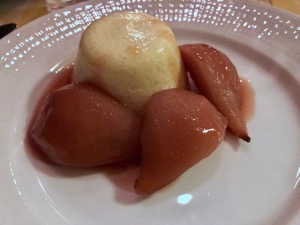
 Dessert, yes, also rather improvised. A store-bought commercial pannetone, some pears Anneke had put up in syrup, a pile of whipped cream, a sugar wafer. I suppose it's a variation of zuppa inglese. Whatever: I'd gladly have had more…